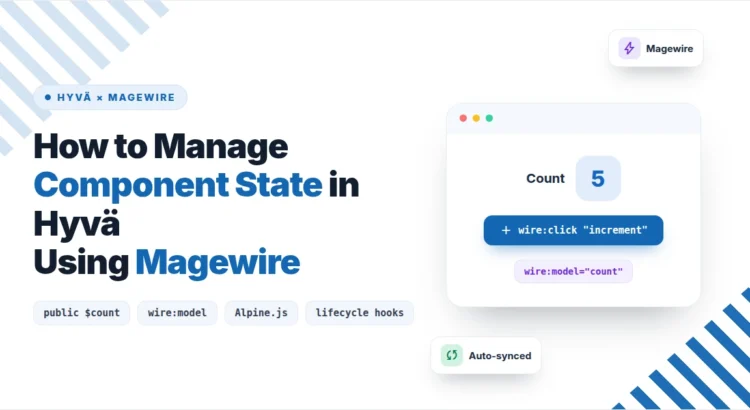
Learning how to manage component state in Hyvä using Magewire is one of the most important parts of building an interactive and reactive storefront.
Magewire makes this simple by allowing PHP properties to stay in sync with the frontend automatically. Instead of writing complex JavaScript, you can manage UI state directly from your Magewire components.
In this guide, you’ll learn how to manage component state in Hyvä using Magewire, how state synchronization works, and how to combine Magewire with Alpine.js for a better user experience.
If you’re new to this, start with our guide on how to create reactive components in Hyvä using Magewire.
What is Component Status in Magewire?
Component state is the data your UI depends on.
For example, counter values, search text, form input, modal visibility, or selected products can all be considered component state.
In Magewire, every public PHP properties automatically becomes part of the component’s state.
Every time the value changes, Magewire sends an AJAX request and only updates the affected HTML, rather than refreshing the entire page.
This server-based approach keeps your frontend clean while reducing JavaScript complexity.
Why Manage Component State in Hyvä Using Magewire?
Using Magewire for state management offers several benefits.
- Write business logic in PHP.
- Automatic data synchronization between backend and frontend.
- Reduce custom JavaScript.
- Keep Hyvä components reactive.
- Integrate seamlessly with Alpine.js.
This makes Magewire a great choice for building dynamic Hyvä components.
Step 1: Declare Component State
Each value that Magewire wants to track must be declared as a public property.
Use mount() lifecycle method to initialize values when the component is loaded.
namespace Vendor\Module\Magewire;

use Magewirephp\Magewire\Component;

class Counter extends Component
{
    public int $count = 0;

    public function mount(): void
    {
        if ($this->count === 0) {
            $this->count = 1;
        }
    }

    public function increment(): void
    {
        $this->count++;
    }
}
That $count properties become part of the frontend state automatically.
Understand mount() Method
That mount() the method is only executed once when the component is first loaded.
Use for:
- Load default values
- Take initial data
- Initialize component state
- Prepare variables before rendering
Different from the method of action, mount() is not executed during each AJAX request.
Step 2: Bind Status in PHTML Template
Magewire exposes components via $magewire variable.
You can display status, trigger actions, and synchronize form fields using wire directives.
<?php $magewire = $block->getMagewire(); ?>

<div>

    <p>
        Current Count:
        <span><?= $magewire->count ?></span>
    </p>

    <button wire:click="increment">
        Increment
    </button>

    <input
        type="text"
        wire:model="count"
    />

</div>
Here:
<?= $magewire->count ?>displays the current state.wire:clickcall a PHP method.wire:modelkeeps input synchronized with PHP properties.
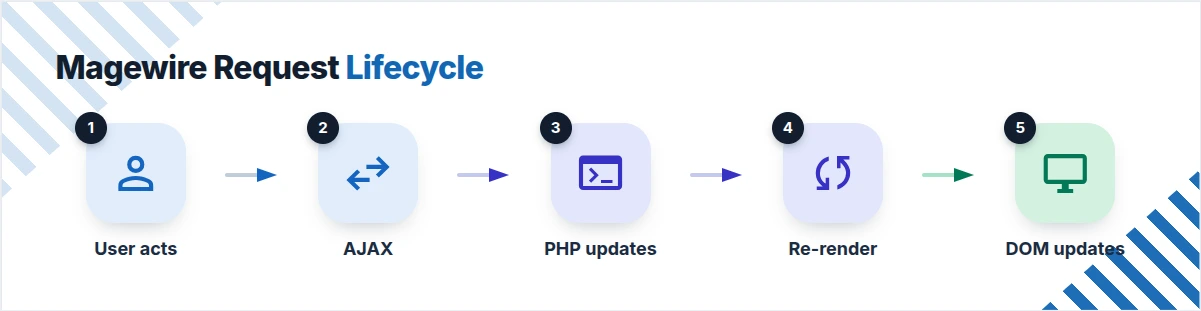
How Status Sync Works
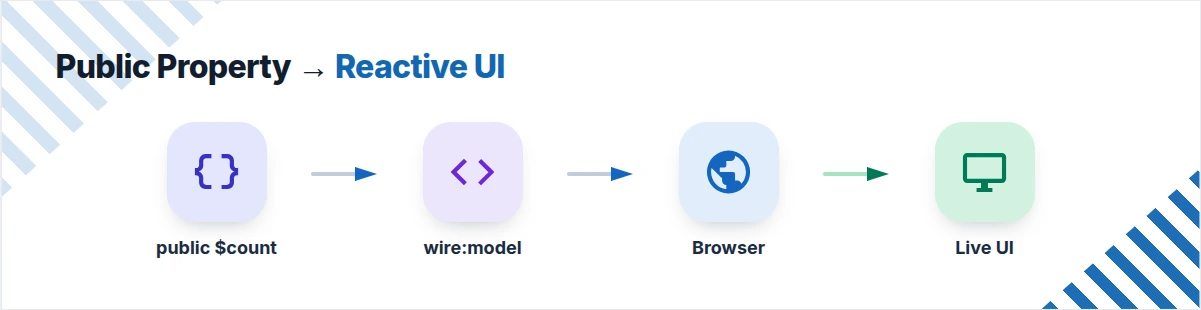
Magewire automatically keeps frontend and backend data in sync.
The workflow is easy:
- A user interacts with a page.
- Magewire sends an AJAX request.
- PHP components update their public properties.
- Magewire simply re-renders the affected HTML.
- The browser receives the updated markup.
This process occurs automatically without writing manual AJAX code.
Choose the Right One wire:model Directive
Magewire provides several synchronization options depending on your use case.
wire:model
Updates properties immediately after each input change.
<input wire:model="count">
Use this when instant updates are needed.
wire:model.lazy
Updates properties only after input loses focus.
<input wire:model.lazy="count">
This reduces unnecessary AJAX requests.
wire:model.debounce.500ms
Waits until the user stops typing before sending the update.
<input wire:model.debounce.500ms="count">
This option works well for search fields and direct filtering.
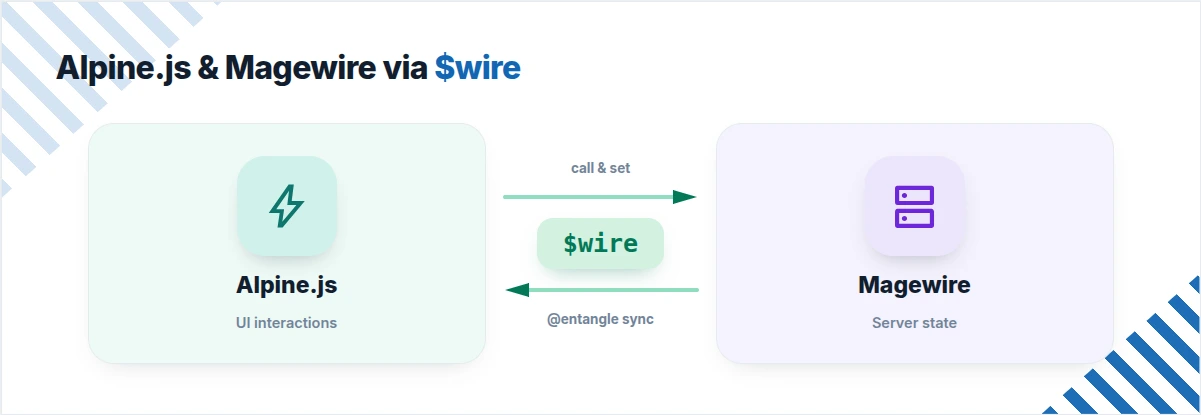
Integrating Magewire with Alpine.js
Hyvä uses Alpine.js for lightweight frontend interactions.
Magewire integrates natively with Alpine, allowing the two tools to work together without conflict.
There are two general approaches.
Option 1: Sync Status with @entangle
That @entangle The directive creates two-way synchronization between Alpine.js and Magewire.
<div x-data="{ open: @entangle('isFormSaved') }">

    <div x-show="open">
        Form submitted successfully!
    </div>

</div>
If PHP properties change, Alpine updates automatically.
Likewise, Alpine changes are synced back to Magewire.
Option 2: Access Magewire Using $wire
You can directly call Magewire methods or update properties from Alpine.
<div x-data="{}">

    <button @click="this.$wire.increment()">
        Increment via Alpine
    </button>

    <button @click="this.$wire.set('count', 10)">
        Set Count to 10
    </button>

</div>
This approach is useful when Alpine controls interactions but Magewire manages application state.
Responding to State Changes with Lifecycle Hooks
Magewire provides a lifecycle hook that runs automatically whenever a property changes.
These hooks are useful for validation, formatting, or applying business rules.
public function updatedCount($value): void
{
    if ($value > 100) {
        $this->count = 100;
    }
}
That updatedCount() method runs immediately after count property changes.
Magewire also supports updating<Property>() hook, which is executed before the property is updated.
These hooks help keep component state consistent without adding additional frontend logic.
Best Practices for Managing Component State in Hyvä Using Magewire
Follow these recommendations when creating Magewire components:
- Maintain component state in public properties.
- Use
mount()just for initialization. - Keep business logic inside PHP methods.
- Choose the right one
wire:modelmodifier for each input. - Use Alpine.js only for light UI interactions.
- Validate state using lifecycle hooks.
- Avoid storing unnecessary data in component properties.
This practice makes components easier to maintain and improve performance.
Common Mistakes to Avoid
Developers often encounter these issues when working with Magewire:
- Declare the country as
privateorprotected. - Places the initialization logic inside the action method.
- Use
wire:modelfor each field unnecessarily. - Mixing too much JavaScript with Magewire.
- Ignoring lifecycle hooks for validation.
Keeping your components focused helps improve readability and maintainability.
Conclusion
Managing component state in Hyvä using Magewire is easy once you understand how public properties, wire directives, and lifecycle hooks work together.
Magewire automatically synchronizes the backend state with the frontend, allowing you to create interactive components without writing complex JavaScript.
When combined with Alpine.js, you get a clean balance between server-based state management and light frontend interaction, making Hyvä development faster, simpler, and easier to manage.

PakarPBN
A Private Blog Network (PBN) is a collection of websites that are controlled by a single individual or organization and used primarily to build backlinks to a “money site” in order to influence its ranking in search engines such as Google. The core idea behind a PBN is based on the importance of backlinks in Google’s ranking algorithm. Since Google views backlinks as signals of authority and trust, some website owners attempt to artificially create these signals through a controlled network of sites.
In a typical PBN setup, the owner acquires expired or aged domains that already have existing authority, backlinks, and history. These domains are rebuilt with new content and hosted separately, often using different IP addresses, hosting providers, themes, and ownership details to make them appear unrelated. Within the content published on these sites, links are strategically placed that point to the main website the owner wants to rank higher. By doing this, the owner attempts to pass link equity (also known as “link juice”) from the PBN sites to the target website.
The purpose of a PBN is to give the impression that the target website is naturally earning links from multiple independent sources. If done effectively, this can temporarily improve keyword rankings, increase organic visibility, and drive more traffic from search results.