Webkul’s AI glasses virtual try-on solves a problem every eyewear business knows: customers cannot see how a frame will look on their own face.
They find a style they like, but they cannot tell whether it suits them or even whether it will fit properly.
Most of them either take the risk or leave the site without buying, and that hesitation costs eyewear businesses sales every day.
Webkul’s AI glasses virtual try-on with PD measurement removes that uncertainty completely.
Customers measure their own pupillary distance and try frames on their live face before they buy.
It runs on ecommerce stores, optical platforms, retail kiosks, marketplaces, and mobile apps, and it needs no special hardware.
What Is AI Glasses Virtual Try-On with PD Measurement?
The AI glasses virtual try-on is a two-step experience built around how people actually shop for eyewear.
The first step measures the customer’s pupillary distance, which is the gap between both pupils in millimetres.
Opticians rely on that number to align lenses correctly inside a frame, so getting it right is what makes a pair feel comfortable.
Measuring PD normally means booking a visit to an optician, but this solution does it automatically instead.
The camera detects the face, tracks both pupils, and calculates the measurement across multiple frames for accuracy.
The second step is the virtual try-on itself, where the customer sees frames placed on their live face in real time.
The AI tracks the face as they move, so each frame stays stable and correctly positioned.
Switching between styles is instant, and the whole experience runs on any platform with a camera.
What the Solution Consists Of
Here is everything the solution includes:
- AI-powered PD measurement
- Real-time facial landmark detection
- Stable face tracking
- Accurate frame positioning and scaling based on measured PD
- Instant frame switching across the full catalog
- Photo capture for saving or sharing a preferred look
- Integration with ecommerce stores, mobile apps, marketplaces, retail kiosks, and optical platforms
How AI Glasses Virtual Try-On Works — Step by Step
The journey from landing to decision takes under two minutes.
Step 1 — Open the experience. The customer opens the virtual try-on on any device with a camera, and there is nothing to download or install.
Step 2 — Measure PD automatically. The AI detects the face and places tracking points on both pupils, then guides the customer to hold still for a few seconds.
It measures the pupillary distance across multiple frames and shows the result on screen.
Step 3 — Move to the try-on. With PD measured, the customer opens the frames experience, and face detection starts right away.
Step 4 — Try frames on a live face. A frame appears on the customer’s live face, scaled to their measured PD.
The AI keeps it stable as they move naturally.
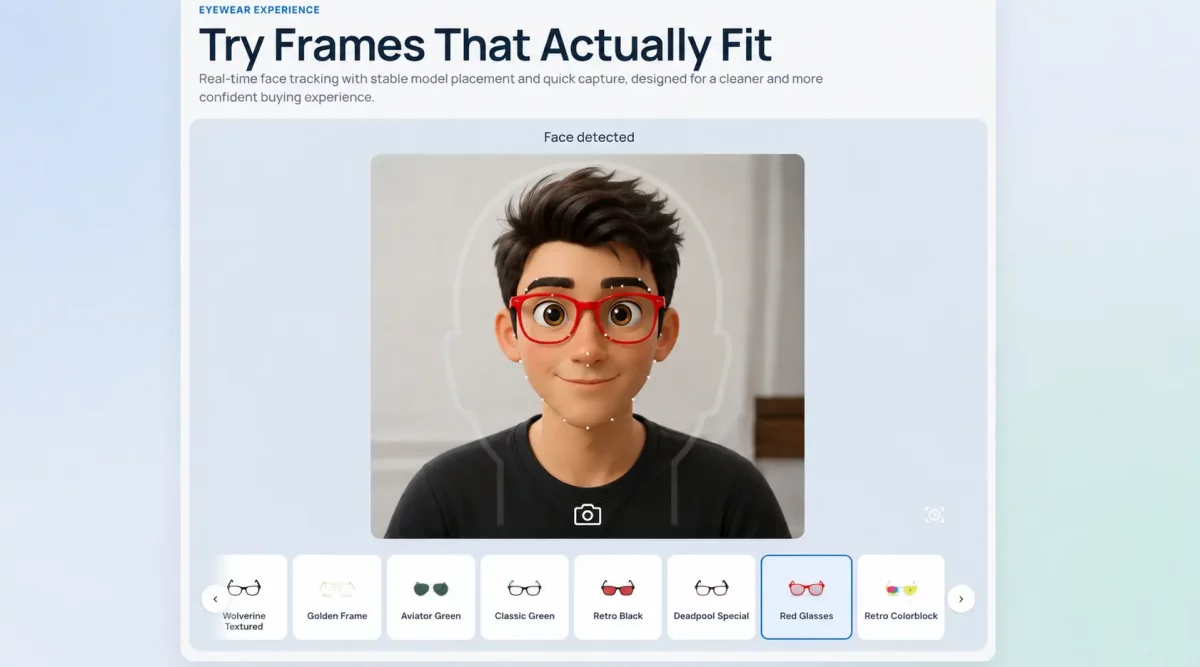
Step 5 — Switch styles and compare. The customer browses the frame carousel, and each style switches instantly.
They compare frames on their own face rather than on a model or a mannequin.
Step 6 — Capture and decide. The customer picks their favourite look and captures a photo.
The business can then route them to checkout, a wishlist, or a sharing option.
Why This Matters for Eyewear Businesses
The main reason customers do not buy glasses online is simple: they are not confident the frame will look good on them.
Virtual try-on removes that barrier, because seeing a frame on their own face gives customers the confidence to commit.
They are more likely to complete the purchase, and they are less likely to return the product afterwards.
Accurate PD measurement adds even more value on top of that.
A customer who has their PD confirmed can order prescription lenses online without ever visiting a store.
That opens up a much larger market, because the catalogue is no longer limited to fashion frames alone.
There is also nothing to install, so customers can try frames wherever they happen to be.
Online Eyewear Retailers
The AI glasses virtual try-on turns product pages into interactive experiences where customers try frames before they buy.
That leads to higher conversion rates and fewer returns.
Optical Chains and In-Store Opticians
Physical stores can extend their catalogue well beyond what sits on the floor, so customers try styles the shop does not stock.
They can also carry on browsing from home after their visit.
Prescription Eyewear Platforms
For platforms selling corrective lenses online, PD measurement is essential, and this solution provides it automatically.
Customers complete prescription orders without booking a separate optician visit.
Luxury and Designer Eyewear Brands
Premium brands need a premium experience, and a polished, accurate try-on matches the quality of the product itself.
It also removes the hesitation that comes with any high-ticket purchase.
Eyewear Marketplaces
Multi-brand platforms can offer one consistent try-on experience across every listed brand.
That gives the marketplace a strong reason to be the customer’s first stop.
D2C Eyewear Brands
Direct-to-consumer brands can deliver in-store quality online, which is a real advantage over competitors who show only static product photos.
Corporate Vision Benefit Programs
Companies with eyewear allowances can embed the try-on directly into their benefits portal.
Employees browse and select frames confidently, without needing an in-person appointment.
Webkul builds practical AI solutions for real business challenges.
Our AI and machine learning practice stays focused on outcomes: higher conversions, fewer returns, and better customer experiences.
The solution is platform-independent, so it works with any existing store, marketplace, kiosk, or vision care platform.
Our generative AI services team can also build a fully custom solution around your specific workflow.
AI glasses virtual try-on with PD measurement gives customers the confidence to buy.
They see how a frame looks on their own face, they know their PD is accurate, and they can decide without any uncertainty.
For online retailers, optical chains, luxury brands, and vision care platforms, this is a better way to sell eyewear online.
Ready to bring AI glasses virtual try-on to your business? Get in touch with Webkul, and we will show you how it fits into your platform.
PakarPBN
A Private Blog Network (PBN) is a collection of websites that are controlled by a single individual or organization and used primarily to build backlinks to a “money site” in order to influence its ranking in search engines such as Google. The core idea behind a PBN is based on the importance of backlinks in Google’s ranking algorithm. Since Google views backlinks as signals of authority and trust, some website owners attempt to artificially create these signals through a controlled network of sites.
In a typical PBN setup, the owner acquires expired or aged domains that already have existing authority, backlinks, and history. These domains are rebuilt with new content and hosted separately, often using different IP addresses, hosting providers, themes, and ownership details to make them appear unrelated. Within the content published on these sites, links are strategically placed that point to the main website the owner wants to rank higher. By doing this, the owner attempts to pass link equity (also known as “link juice”) from the PBN sites to the target website.
The purpose of a PBN is to give the impression that the target website is naturally earning links from multiple independent sources. If done effectively, this can temporarily improve keyword rankings, increase organic visibility, and drive more traffic from search results.